


Our aim:
That’s why we’ve developed CardioCheck by myritmo for you, for just:
CardioCheck – BASIC
A quick check of your heart
(4)
- 30-second ECG
- Heart rate check
- Screening for heart rhythm irregularities
- Alerts to findings that may require medical follow-up
Ideal for:
Anyone who wants to keep an eye on their heart health regularly — easily and reliably.
19,90 €
incl. tax
CardioCheck – PLUS
In-Depth Heart Rhythm Analysis
(9)
- 30-second ECG
- Heart rate check
- Assessment of abnormalities in cardiac conduction
- Identification of extra beats originating in the atria or ventricles
Ideal for:
People experiencing palpitations, an irregular pulse, symptoms such as dizziness, or those seeking a more detailed assessment of suspected heart rhythm issues.
26,90 €
incl. tax
CardioCheck – PREMIUM
Comprehensive Heart Rhythm Analysis & Risk Assessment
(12+)
- 30-second ECG
- Heart rate check
- Detailed heart rhythm analysis
- Assessment of abnormalities in cardiac conduction
- Identification of extra beats originating in the atria or ventricles
- Assessment of rare but clinically relevant risk patterns
- Screening for atrial fibrillation and potential early indicators
Ideal for:
Active individuals, athletes, and fitness enthusiasts who want to keep a closer eye on their heart before or after training or competition.
29,90 €
incl. tax
The maximum number of ECG parameters tested – explained simply
- Basic Rhythm – Indicates whether the heart is beating in a normal sinus rhythm or whether another basic rhythm is present.
- Heart Rhythm Disorders – Detects rhythm disorders such as atrial fibrillation, atrial flutter, fast and slow heart rhythms originating in the atria or ventricles, as well as other abnormalities in heart rhythm.
- Brief atrial arrhythmias – Detects brief sequences of rapid heartbeats that may originate in the atria and may indicate an increased tendency toward arrhythmias.
- Heart Rate (HR) – Indicates how many times the heart beats per minute and whether the heart rate is too slow, too fast, or within the normal range.
Key ECG measurements (PQ interval, QRS duration, QTc interval) that show how electrical signals are generated, transmitted, and recover after each heartbeat. They provide important information about the heart’s electrical activity and function.
-
- PQ interval – Describes the conduction of electrical signals from the atria to the ventricles. Abnormalities may indicate changes in cardiac conduction and may be associated with arrhythmias as well as an increased risk of falling or fainting.
- QRS complex – Indicates the electrical activation of the ventricles. Abnormalities may indicate cardiac conduction disorders or changes in the heart muscle.
- QTc interval – Describes the heart’s electrical recovery after a heartbeat. Abnormalities may indicate an increased risk of arrhythmias, as well as dizziness, falls, or fainting spells.
- PACs – Extra heartbeats that can originate prematurely in the atria.
- PVCs– Extra heartbeats that can originate prematurely from the ventricles.
Certain combinations of ECG features (T wave, QTc, ventricular preexcitation) that may indicate an increased risk of clinically significant arrhythmias.
-
- T-wave—Changes in the heart’s electrical recovery may indicate an increased risk of cardiac arrhythmias.
- QTc Prolongation – A prolonged electrical recovery time in the heart may be associated with an increased risk of cardiac arrhythmias, as well as dizziness or fainting spells.
- Ventricular preexcitation – An additional electrical pathway in the heart that can contribute to certain types of arrhythmias.
This is how it works:


Send us your ECG data directly by e-mail to: cardio@myritmo.com
Please send us only one ECG file (PDF)
per e-mail!
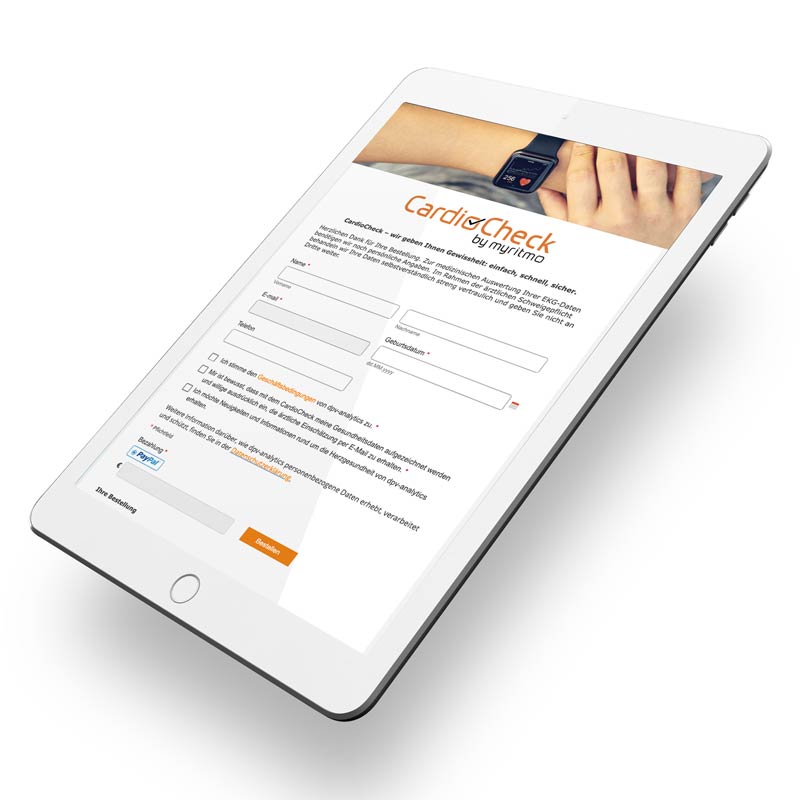

You will immediately receive a confirmation of receipt by e-mail. This will contain a link to the order form on our website. Please complete your order and payment there.


Upon receipt of your payment, analysis of your ecg data will immediately begin. You will receive your report by e-mail within one business day*.
Our cooperation partners:


What should I do if my smartwatch shows an ECG abnormality?
Many smartwatches or fitness trackers record short-term ECGs and can therefore indicate the presence of dangerous atrial fibrillation. A medically sound monitoring.
Approximately 1.1 million inhabitants of Europe suffered a stroke each year. Atrial fibrillation is the number one risk for strokes: it increases the risk of a stroke by around 5 times. It is estimated that 7.6 million people over 65 in the EU had atrial fibrillation in 2016 – mostly unrecognized – and this will increase by 89% to 14.4 million by 2060.
In the case of atrial fibrillation, a specialist assessment is urgently required. But in our overburdened healthcare system, this can take a long time – often too long.
To close this gap in care, we have developed CardioCheck by myritmo. Simply forward your ECG recording from your device by email to cardio@myritmo.com – and you will receive your ecg report the very next working day.
Would you like a more intensive CardioCheck?
To reliably clarify indications of other cardiac arrhythmias or atrial fibrillation, a long-term ECG is still recommended. This records your heart activity with at least 3 channels in order to obtain medically reliable data. Wearables only have 1 channel, which only measures the heartbeats over 30 seconds. They are therefore significantly less accurate.
Our mini ECG myritmo – a wireless, passport photo-sized device – records your heart activity over 72 hours and thus provides a detailed picture of your heart health: quickly, reliably and safely. We therefore recommend heart screening with myritmo.

Our mission is to prevent strokes!
From treatment to prevention
Hundreds of thousands of people in Germany live with cardiac arrhythmia without realising it because the prevailing long-term ECG is time-consuming, labour-intensive and costly. Many secondary diseases, such as strokes, are not prevented in time. With serious consequences for patients – but also for health insurance companies and the community. We want to and will change this.
Our doctors have set themselves the goal of using the possibilities of modern digital technology to break new ground in diagnostics.
Wearables are a particularly low-threshold screening option for everyone. The wristbands with built-in intelligent computer technology can do more and more: they record vital parameters such as pulse, heart rate and oxygen saturation, record atrial fibrillation and cardiac arrhythmia. Wearables are convenient for everyone to use and this ECG data can be analysed quickly and safely at any time by CardioCheck. We are proud to be able to offer CardioCheck by myritmo to everyone in an uncomplicated and cost-effective way.
Our scientific foundations
We base the statistical classification of individual ECG values on established medical literature and recognised international guidelines. The sources listed below represent a selected extract from the scientific references consulted. They form part of the technical basis for our analysis and support a structured classification of the measured heart rhythm and ECG parameters.
Thieme. Langzeit‑EKG Auswertung einfach gemacht.
Thieme. EKG‑Kurs für Isabel. 8. Auflage.
American Heart Association (AHA). ACLS Guidelines Update 2025.
ACC/AHA/HRS Guideline for Supraventricular Tachycardia (2015).
ACC/AHA/HRS Guideline for Bradycardia (2018).
Soos MP, McComb D. Sinus Arrhythmia. StatPearls.
Saoudi N et al. Ventricular tachycardia in salvoes. Arch Mal Coeur Vaiss. 2003.
Disclaimer
*Working days are Monday to Friday excluding public holidays.
Your data will only be processed in compliance with data protection regulations for the purpose of screening for atrial fibrillation and other cardiac arrhythmias in accordance with your consent.
The CardioCheck is only available to people over the age of 18, as this service is intended for adult users.
Disclaimer
Legal Basis: Scope of Services, Liability, Treatment and Medical Discretion
dpv-analytics GmbH provides the user with a graphically presented summary of the transmitted ECG data (“CardioCheck Report”). This CardioCheck Report is intended exclusively for the user’s self-monitoring of their own health data and does not replace a medical examination, consultation, and/or diagnosis. The content of the CardioCheck Report is generated by medically certified software. The program compares the submitted user and ECG data with the target values defined as the normal range in medical literature and cardiology guidelines, thereby determining the statistical risk of a cardiac condition based on these values. The CardioCheck report is not suitable for an individual evaluation or assessment of vital signs. A “green” risk indicates a statistically normal value but does not rule out the presence of a risk or disease. A “yellow” or “red” risk merely indicates statistical abnormalities but does not provide a diagnosis of a pathological condition. dpv-analytics GmbH conducts random quality control checks of the generated results using medically trained personnel. There is no individual review of the CardioCheck report.
dpv-analytics GmbH is liable for damages only to the extent that they result from a breach of a material contractual obligation or from intentional or grossly negligent conduct on the part of its legal representatives or agents. Excluded from this limitation of liability are damages resulting from injury to life, body, or health. Mandatory liability under the Product Liability Act also remains unaffected by this exclusion of liability. dpv-analytics GmbH prohibits any unauthorized use of the CardioCheck report by physicians. The CardioCheck report does not contain any medical findings; physicians may not use the CardioCheck report as the basis for a diagnosis or treatment.
Company address: DPV-Analytics GmbH – Schloßstraße 12 – 22041 Hamburg
As of: 2026